Certificate lifecycle automation as operational imperative
Trust Architecture Playbook: Automation pillar
Regulatory requirements: Reduced validity, increased friction
Rarely are certificate-related outages and security failures caused by cryptography alone. Often, they are the result of weak operational discipline (for example, unclear ownership, undocumented installation points, inconsistent issuance practices) as well as insufficient controls around who can request which certificates and from where. This has long been a struggle, what has changed now is the rate at which these gaps become incidents.
Due to changes from the CA/Browser Forum, public-trust certificates are rapidly moving toward a maximum validity of 47-days. In March 2026, the maximum validity was effectively cut in half from 398 days to a new maximum validity of 200 days:
At current validity periods, an organization with 1,000 public certificates requires approximately 2,000 successful renewal-and-deploy cycles per year.
When we reach 47-day validity, that number grows to roughly 7,800. A 1% failure rate that produced 20 incidents per year at annual renewal today produces 78 at 47-day validity.
Manual renewal is mathematically incompatible with this new reality. The question isn’t whether to automate, it’s how to automate safely, at scale.
Aviso
The operational math
At 47-day certificate validity: 1,000 certificates × ~7.8 renewals/year = 7,800 renewal-and-deploy cycles annually. At a 99% success rate, that is still 78 failures per year. At 98%, it is 156.
Not exclusively a public-trust problem
Private-trust PKI use cases such as internal TLS, mTLS, workload identity, and machine-to-machine authentication are growing at rates that exceed what manual processes can absorb regardless of validity period. The volume of machine identities in a typical enterprise now dwarfs the number of human identities, and that gap continues to widen as microservices architectures, AI agents, and cloud-native workloads become standard operating patterns.
The machine identity inflection point
Concerns with certificates are no longer primarily about web servers. Workload identity, service mesh/mutual TLS, agentic AI, DevSecOps, and API gateways now represent the fastest-growing segments of a typical enterprise’s certificate estate. These use cases share several characteristics that make manual management prohibitive, including:
High volume
Ephemeral/short lifetimes by design
Dynamic provisioning (buildup/teardown)
Tight coupling to automated deployment pipelines
Trust Lifecycle Manager supports current-generation workload identity patterns including cert-manager and Istio-based service mesh automation using ACME, with SPIFFE/SPIRE-compatible certificate profiles for workload identity assertion. The governance model established in this guide — criticality tiers, readiness gates, profile constraints, and control loops — applies to workload identity automation exactly as it applies to server and appliance automation.
Organizations should look to encompass machine/workload identity from the outset, not as a later expansion. The governance framework is the same; the specific implementation patterns are different.
Public vs. private trust: A false equivalency
Many organizations split their certificate estate into two operating models:
Public-trust TLS
Everything else
While this bifurcation has some utility from a policy standpoint, it’s not a properly considered basis for automation design. The more important considerations are:
Business criticality
Blast radius
Sensitivity
Operational complexity
Often, private-trust certificates support highly sensitive internal authentication or workload identity functions that need stronger controls than, for example, a lower-risk public-trust use case. Conversely, some public-trust deployments are straightforward and well-suited for broad automation. Organizing automation efforts and priority using primarily the public/private divide obscures these distinctions and leads to a non- or under-governed private-trust environment with over-engineered, low-criticality public-trust flows.
Public vs. private-trust is an important factor as an input into policy and implementation decisions (particularly profile design and audit requirements), but should not be used as the sole or primary basis for automation cadence or control design. Ultimately, a criticality-based model produces better automation outcomes.
The right mindset: Governed control plane, not convenience layer
The most common root-cause of failures in certificate automation programs is that organizations treat automation as solely a way to reduce administrative effort. That framing produces problematic design decisions: automation that is designed to primarily save time tends to skip controls focused on the availability, reliability, and confidentiality of systems, as well as forgoing ownership validation, deployment confirmation, rollback testing, and failure detection.
The correct way to frame automation is to recognize that certificate lifecycle automation is a governed control plane for enforcing policy, authorization, auditability, and consistent operational outcomes. When designed and deployed with that intent, automation will reduce manual effort, but it also reduces risk, improves reliability, and creates an operational foundation ready for scale.
This mindset also helps inform where automation begins: best practice is to start in critical environments where service behavior tends to be well understood, installation points stable, and ownership clearly defined. The goal is to establish predictable outcomes before expanding into more complex or bespoke environments. The operating principle is controlled progression guided by risk, not a rapid enterprise-wide expansion.
Renewals and rotations should be treated as continuous operational change — not isolated scheduled tasks — which may require some rethinking of how maintenance and change windows work vis-a-vis TLS certificates. Monitoring, rollback capability, and incident response are design requirements.
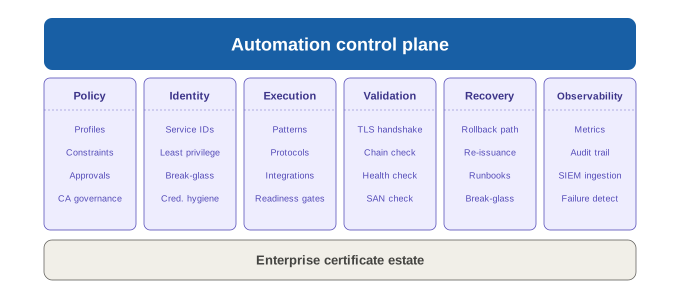 |
How the automation control plane works
The automation control plane operates as a continuous, closed-loop system where each capability works together to ensure secure, reliable, and compliant automation.
Policy defines what can be issued, to whom, from which CA, under what constraints, and for how long. Every other pillar operates within the boundaries that policy establishes. If those boundaries are poorly designed (for example, profiles too broad, naming rules too loose, approval paths unclear), the downstream pillars enforce the wrong thing at scale. Policy is the pillar that shapes all the others.
Identity determines who and what is permitted to act within those policy boundaries. Service identities, automation credentials, ACME accounts, and connector identities are the actors that execute automated lifecycle events. Least-privilege scoping ensures that each actor can only do what is required for its specific role. Break-glass access provides a governed emergency path when standard automation cannot respond in time. Without the identity pillar, policy has no enforcement model, so anyone or anything could request anything.
Execution is where policy intent and identity authorization meet operational reality. The selection of the right pattern and protocol for each platform that hosts a portion of the certificate estate. Readiness gates are part of this pillar: they ensure automation is only introduced into environments where execution can be deterministic and repeatable. Execution without policy is ungoverned issuance. Execution without identity is unaccountable issuance.
Validation closes the loop: issuance success is not deployment success, and validation is the mechanism that enforces that distinction. TLS handshake checks, chain validation, SAN verification, and service health checks together confirm that the certificate the CA issued is the certificate the service is presenting. Without validation, the other five pillars can be operating correctly while production services silently present expired or mismatched certificates.
Recovery is the answer to what happens when validation fails or when automation fails before validation even runs. Rollback paths, reissuance procedures, break-glass flows, and documented runbooks transform a failure event into a managed operational response. Recovery is what makes the system trustworthy under pressure.
Observability holds everything together over time: metrics, audit trails, and SIEM ingestion make the state of the entire system visible and reveal where automation works, where it fails, where exceptions are accumulating, and whether the other five control plane pillars are producing the outcomes they were designed for.
Continuous feedback loop
Together, the pillars of the automation control plane create a self-reinforcing cycle:
Policy defines rules
Identity enforces trust
Execution performs actions
Validation verifies outcomes
Recovery corrects issues
Observability provides insight
Each step feeds the next, resulting in automation that is not only efficient, but also adaptive, resilient, and continuously improving.