Automation readiness gates
Trust Architecture Playbook: Automation pillar
Automation doesn't create operational discipline, it exposes the lack of it, and at a speed much faster than manual processes. A certificate renewed and deployed through a well-governed automation pipeline is more reliable than any manual process. But automating a certificate without understanding its ownership, deployment path, and behavior leads to failures that hit quicker, propagate faster, and are harder to diagnose. The automation pipeline becomes an accelerant, not a safeguard. This is why readiness gates matter.
Defining readiness gates
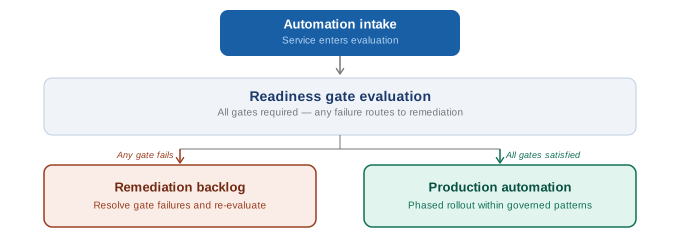
Readiness gates are the go/no-go mechanism that determines whether automation is being introduced into a controlled, understood environment versus one where issues only become visible when something breaks in production. Any service/system that enters the automation intake process should be evaluated against a defined, consistent set of criteria before a single automated renewal runs in production.
This means defining, in advance, the specific evidence required to pass each gate. The evidence should consist of documented, verifiable artifacts: a named owner with a tested escalation path, confirmed and reachable install locations, a deployment method that’s been executed successfully and repeatably, appropriate post-deployment validation methods, a tested rollback path for higher-criticality services. Monitoring should be established and active before the first automation runs.
This also means defining, in advance, what happens when a gate isn’t satisfied. Each type of gate failure requires a specific remediation path, which may include actions such as inventory cleanup, deployment engineering, profile redesign, connector preparation, monitoring configuration, or exception review. The default disposition for a gate failure is remediation, not a workaround or verbal commitment to fix it later, and not an exception that becomes permanent. Services that are unable to meet the gates aren’t ready for automation. Discipline is required in enforcing that conclusion consistently, even when there's schedule pressure to move faster.
The intake process that results from this work should feel rigorous, because it is. The upside of that rigor is an automation program where failures are rare, recoverable, and understood.
Important
Decision rules
Define readiness gates that are right for your organization and your processes.
If a readiness gate is not satisfied, route the certificate to the remediation backlog, not to production automation.
Outside of full gate satisfaction, the only exceptions should be time-limited with carefully approved compensating controls.
Decision framework: Should this certificate be automated now?
Is the application or service owner identified and reachable through our existing support model? Is the platform owner identified?
Is every installation point known, reachable, and represented in the inventory?
Is the deployment method documented and deterministic? Does it include restart/reload behavior, clustered or active-active dependencies, etc.?
Is post-deployment validation defined (for example, TLS handshake checks, chain validation, SAN checks, etc.) where applicable?
Is the rollback and recovery process documented, with reissue or revert steps tested for higher-criticality services?
Is the service assigned to an approved profile, business unit, etc.?
Are expiry, issuance, deployment, renewed-but-not-deployed failures, and other exceptions monitored and routed to the right owners?
Has blast radius been assessed for shared certificates, or cross-service dependencies, key compromise, etc.?
Readiness gate examples
Gate | Minimum evidence | Fail state / remediation |
|---|---|---|
Ownership | Identified service owner and platform owner, escalation path documented. | Do not automate until ownership is defined and recorded in inventory. |
Inventory accuracy | Known install locations, environment, hostname scope, connector target, owner, metadata, etc. | Correct discovery data, tags, and service mapping before proceeding. |
Deployment path | Documented install and reload behavior, including HA or clustered nodes. | Engineer a deterministic method or keep the workflow manual. |
Validation | Appropriate handshake, chain, SAN, service health, etc. checks are defined and testable. | Create synthetic or platform-native validation before rollout. |
Recovery | Rollback or reissue process documented; Tier 0 and Tier 1 rehearsed. | No production automation until failure recovery is credible and tested. |
Authorization | Approved profile, business unit, service identity, and least-privilege scope confirmed. | Redesign RBAC, profile scope, or credential model. |
Monitoring | Alerts exist for expiry, renewal failure, deployment failure, etc. | Add telemetry and routing before go-live. |
Blast radius | Shared certificate or shared listener assessment complete. | Split dependencies or add stronger change and rollback controls. |
 |
Automation readiness checklist
Certificate has an assigned criticality tier.
Service owner and platform owner are recorded in inventory with escalation path.
Install locations and endpoints are recorded and validated.
Profile assignment is confirmed and constraints are appropriate for the tier.
CA source is approved and documented for the profile.
Deployment method is documented and repeatable, including restart/reload behavior.
Post-deploy verification exists for TLS presentation and, where needed, application health checks.
Alert routes and escalation by tier are configured and tested.
Rollback or recovery procedure exists and is rehearsed for Tier 0 and Tier 1 services.
Blast radius assessment is complete for any shared certificate or shared listener.
Common blockers: Do not automate until resolved
Some issues should be considered absolute blockers to automation where no compensating control makes automation safe until the underlying condition is resolved.
Ownership is unknown or disputed: Accountability, change approval, and incident response all depend on this.
Installation points are unknown or certificates are deployed across untracked locations: Incomplete automation introduces unnecessary risk.
Deployment cannot execute reliably within the required renewal window: Stabilize the deployment process first.
Certificates shared across unrelated services without defined blast-radius controls: A single dependency spanning multiple services multiplies any failure impact.
Monitoring and alerting for expiry, renewal failure, and deployment failure are not in place: Automation without detection is a liability, not an asset.